Why Agencies Need an AI Visibility Offering in 2026
By Joe Della Mora, Founder, GroundScore
If you run an SEO, content, or digital marketing agency, you have probably had the conversation already. A client forwards an article about ChatGPT eating into Google traffic, or asks whether their site shows up in Perplexity, or wants to know "what are we doing about AI search?" Most agencies do not have a good answer yet. That is the opportunity, and in 2026 it is still early enough to take. An AI visibility offering is the productized answer to that client question: measure how clients appear in AI engines, fix what blocks them, and prove movement every month. This guide goes past the pitch and into the operations: what the service includes deliverable by deliverable, how to package and price it against effort, and a concrete path to launching it with your existing clients this quarter.
Why are clients asking agencies about AI search?
Direct answer: Clients ask because they see the shift themselves: they use ChatGPT for research, read headlines about AI eating search traffic, and wonder whether their own site shows up in Perplexity. They may not grasp the mechanics, but they grasp the stakes, and they expect their agency to have an answer.
Every business owner with a website is noticing the same thing: the way people search is changing. AI-powered engines are not a niche anymore. They are mainstream tools used daily for research, comparison shopping, and decision-making, and your clients are users themselves. The question stops being abstract the first time an owner asks ChatGPT about their own industry and sees competitors named where they are not.
Your clients may never learn what AI search visibility technically involves, but they understand the implication perfectly: if their competitors show up in AI answers and they do not, they are losing business they never even saw.
This creates natural demand for a service category most agencies have not formalized. And the demand has an uncomfortable edge for incumbents: when a client asks their current agency about AI search and gets a shrug, that client starts taking calls from whoever does have an answer. The question is a loyalty test whether or not you signed up for one. Agencies that respond with a scored report and a plan turn the moment into a retainer expansion. Agencies that respond with "we're looking into it" are, at that moment, training the client to look elsewhere.
What makes AI visibility a strong agency offering?
Direct answer: AI visibility works as an agency service because it is recurring, measurable, differentiated, and adjacent to work you already do. Results change constantly, so monitoring fits a retainer. Scores and action items make value concrete. And few agencies have formalized the offer, so early movers own the positioning.
Four properties make this a genuinely good service line rather than a trend to chase.
It is recurring. AI search results change constantly, so monitoring and optimizing is an ongoing process, not a one-time audit. That fits a retainer model naturally, without the artificial recurring-ness of some agency deliverables.
It is measurable. Unlike marketing activities where ROI is fuzzy, AI visibility produces concrete scores and specific action items. You can show clients exactly what changed, what you fixed, and how their visibility moved. Renewal conversations get much easier when the deliverable is a trend line.
It is differentiated. Right now, very few agencies offer this in any formalized way. Being early means positioning yourself as the expert before the market gets crowded, and crowded is coming.
It pairs with existing services. AI visibility work overlaps heavily with technical SEO, content strategy, and structured data. You are not learning a new discipline; you are extending one you already sell, which means your existing team can deliver it after a short ramp.
The agencies I talk to while building GroundScore mostly worry they need deep AI expertise to sell this credibly. They do not. The work is robots.txt rules, schema markup, content structure, and disciplined measurement, which is to say it is agency work with a new measurement layer on top.
What does an AI visibility service actually include?
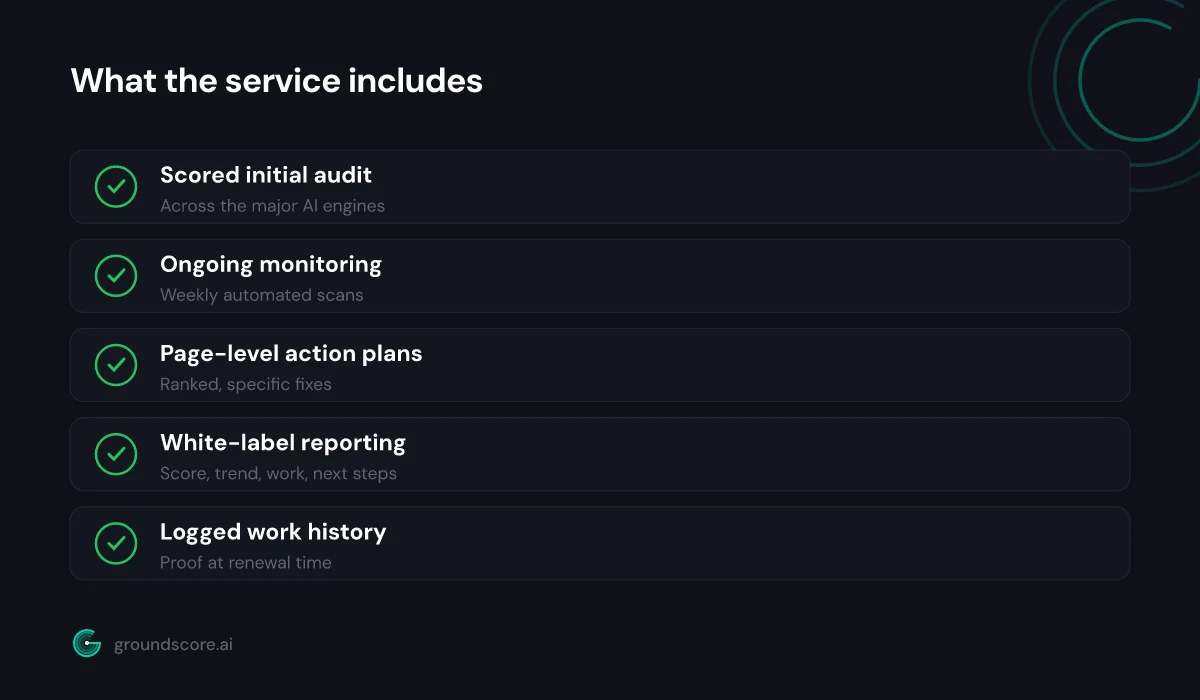
Direct answer: A complete AI visibility service includes an initial scored audit across the major engines, ongoing automated monitoring, ranked page-level action plans, white-label client reporting, and a work log that proves what was done. The audit sells the engagement; the monitoring and reporting justify the monthly retainer.
A practical offering has five deliverables.
Initial audit. Scan the client's site across multiple AI engines. Score their current visibility, and identify the specific gaps: blocked crawlers, missing schema, absent citations. This is your sales artifact too; a weak score with named causes sells the engagement better than any deck.
Ongoing monitoring. Automated weekly scans that track score changes. When visibility drops, you know immediately and can investigate. When it improves, you report the win before the client thinks to ask.
Action plans. Ranked, page-level recommendations with specific fixes. Not "improve your content," but "add FAQ schema to the pricing page, because it answers a question ChatGPT currently answers without citing you."
Client reporting. White-label reports that show the score, the trend, what you did, and what is next. Professional deliverables that justify the retainer month after month.
Work logging. Track what actions were taken and when. This is your proof of value when renewal conversations happen, and the difference between "trust us" and "here is the record."
How should you package and price the offering?
Direct answer: Price against effort and stakes, not tool cost. An add-on to an existing SEO retainer lands around $200 to $500 per month, a standalone offering around $500 to $1,500, and a premium tier with weekly delivery and portal access can run $2,000 or more for high-value clients.
AI visibility slots into existing retainer structures without inventing a new billing model:
| Package | Monthly price | What it includes |
|---|---|---|
| Retainer add-on | $200 to $500 | Monitoring plus monthly action plan delivery |
| Standalone service | $500 to $1,500 | Monitoring, action plans, monthly reporting |
| Premium tier | $2,000 and up | Weekly action delivery, portal access, priority work |
The add-on is the easiest sale: your existing SEO clients already trust you, the topic is already coming up, and the incremental delivery cost is low once your workflow exists. The standalone tier is where new-client acquisition happens, priced by site size and scan frequency. The premium tier is for clients where AI answers plausibly drive real revenue and who want to see work happening weekly.
Two pricing principles keep the model healthy. First, anchor the price to the client's stakes, not your costs; a client whose customers genuinely research through AI engines is buying protection for a revenue channel, and the price should reflect that. Second, keep your tooling cost fixed and predictable while your retainers scale with value delivered. That spread is the margin, and it is why productized services beat hourly billing here: the marginal cost of client number eight is far below the marginal revenue.
Do not price against DIY. Your buyer is the client who wants it handled, not the one weighing DIY against tools and agencies on a spreadsheet.
How does GroundScore's agency plan fit the model?
Direct answer: GroundScore's agency plan runs $499 per month with three client sites included and $149 per additional active site. It handles the scanning, scoring, action plans, and client-ready reporting, so your margin is the gap between a fixed tool cost and retainers priced on the value of the work.
Full disclosure: GroundScore is our product, so this section is the sales pitch, kept short and checkable.
The agency plan exists to be the tooling layer under exactly the service described above. It scans client sites across ChatGPT, Claude, and Perplexity, scores each one 0 to 100 across three pillars, generates the ranked action plans your team executes, and produces the client-facing reports that carry your brand into the monthly meeting.
The math is the point. At $499 per month with three client sites included, two retainers at $300 cover the tool, and every retainer after that is margin on work you were partially doing anyway. Additional sites at $149 each mean the tool bill grows slower than the roster: ten client sites works out to about $154 per site per month. You are reselling measurement and packaging judgment, which is what agencies have always done, with the expensive part automated.
What the plan deliberately does not do: the fixes themselves. Your team still edits robots.txt, ships schema, and restructures content, because that execution is what the client is paying you for. Details are at the agencies page.
How do you get started this quarter?
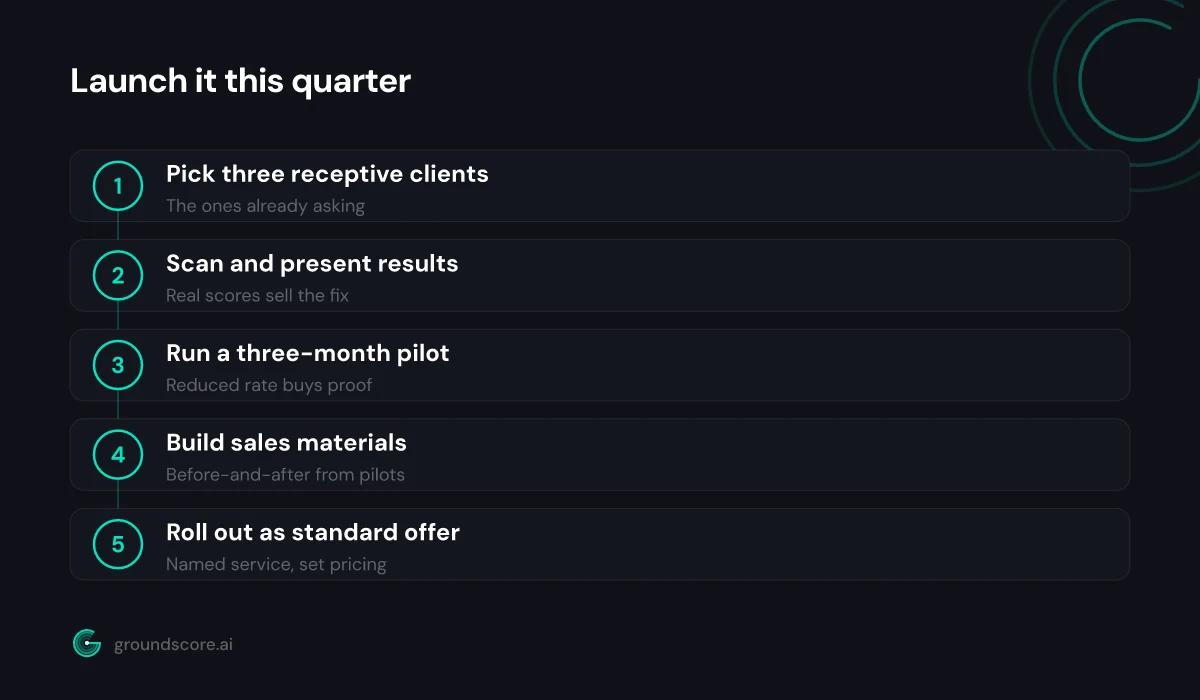
Direct answer: Pick three existing clients who have asked about AI search, run initial scans, and present the results. Offer a three-month pilot at a reduced rate to prove the model, then use those pilots to build your sales materials and roll the service out as a standard offering.
The agencies that move first will own the category positioning in their market. A practical path, one quarter long:
- Pick three existing clients who have asked about AI search or would be receptive. Existing trust shortens every later step.
- Run initial scans and present the results. A real score with named gaps turns an abstract topic into a decision. Weak results sell the fix; strong results sell the monitoring.
- Offer a three-month pilot at a reduced rate. You are buying proof, process, and testimonials; the discount is tuition.
- Build your sales materials from the pilots. Before-and-after scores, the work log, and the reporting samples become the deck for every prospect after.
- Roll it out as a standard offering with the packaging and pricing above, and put it on your site as a named service.
The pilot phase is also where your internal workflow gets honest: who reads the scan, who does the fixes, who presents the report. Solve that with three friendly clients rather than ten paying ones.
Frequently asked questions
Do we need AI specialists to offer this credibly?
No. The work is technical SEO, structured data, content structure, and disciplined measurement, all skills a competent SEO or content team already has. The new parts are the measurement layer and the vocabulary, both learnable in weeks. Clients are buying accountability and execution, not research credentials.
What should we charge for AI visibility monitoring?
Anchor to the client's stakes. As an add-on to an existing retainer, $200 to $500 per month is a defensible range. Standalone engagements run $500 to $1,500 depending on site size and scan frequency, and premium clients with real AI-driven revenue exposure can justify $2,000 or more.
How do we prove the service is working?
With a baseline score, a trend line, and a work log. Scan before you start, report score movement monthly, and tie each change to logged actions your team took. Citation wins, where an engine starts referencing the client in answers it previously ignored them in, are the clearest proof clients understand.
Is it too early to sell this to clients?
The opposite problem is more real: it is early enough that clients are asking before most agencies have an answer, which is precisely the window where positioning is cheap. Waiting until every agency has an AI visibility page means competing on price instead of on being the one who was ready.
Can the reporting carry our agency's brand?
Yes. GroundScore's agency plan produces white-label, client-facing reports designed to be presented as part of your service, showing the score, the trend, and the work completed. Your client relationship stays yours; the tooling stays invisible. That separation is deliberate, because the retainer belongs to the agency, not the software.
The bottom line
The demand is real, the service model is proven agency economics, and the tooling exists. AI visibility is recurring, measurable, differentiated work that your current team can deliver to your current clients, starting with the three who have already asked about it. The only genuinely scarce resource is the early-mover positioning, and it goes to whichever agency in your market formalizes the offer first.
If that should be you, see how the GroundScore agency plan fits under your brand, and be the agency with the answer.
How visible is your site in AI search?
Check your AI visibility score in seconds. Free, no account needed.
Check your score