What E-E-A-T Really Means for AI Search, Not Just Google
By Joe Della Mora, Founder, GroundScore
E-E-A-T stands for experience, expertise, authoritativeness, and trust. For years it lived inside Google's search quality guidelines as advice for the human raters who grade search results. AI search changed what the framework is for. When ChatGPT, Claude, or Perplexity decide which sites to cite, they lean on the same four signals, except they read them as data rather than as a rater's impression. Building GroundScore, the pattern we keep seeing is sites with genuine expertise that no engine can verify, because none of it is encoded anywhere a machine looks. This guide treats E-E-A-T as signals you can actually mark up, not a vibe. Here is what each letter means for AI search, why engines weigh them, and how to encode experience, expertise, authority, and trust so a system can act on them.
What does E-E-A-T mean for AI search?
Direct answer: For AI search, E-E-A-T is the set of experience, expertise, authoritativeness, and trust signals an engine can read from your site and the wider web to decide whether you are a credible source worth citing. It is the same framework Google uses, read as data rather than a human rater's judgment.
The four letters are not interchangeable, and they fail in different ways. Experience is first-hand: did the person who wrote this actually do the thing? Expertise is depth: does the author know the subject well enough to be right about the hard parts? Authoritativeness is recognition: does anyone beyond your own domain treat you as a source? Trust is verification: can a system confirm you are who you claim to be?
Google added the second E, experience, in December 2022, precisely because a lot of confident content is written by people who have never touched the subject. AI engines inherit that concern. A generated answer that cites you is putting its own credibility on the line, so the systems behind those answers reward sources that look accountable and penalize sources that look anonymous.
The shift worth internalizing is that E-E-A-T is no longer graded by a person reading your page and forming an impression. It is increasingly assembled from structured signals: who the author is, what organization stands behind the page, whether the same identity shows up consistently across the web. If those signals are missing, the expertise might be real and still invisible.
Experience and expertise: encoding first-hand knowledge
Direct answer: Encode experience and expertise by attributing content to a named, real author with a machine-readable bio, credentials, and a job title, using Person schema wired to the article. First-hand detail in the writing itself, dated and specific, signals genuine experience that generic, sourceless prose never can.
Most sites publish content with no visible author at all, or a byline that leads nowhere. To an engine, that is a page with no one behind it. The fix is to make authorship real and structured.
Start with the human layer. Give every substantive page a named author with a genuine bio, and write in a way that shows the work: specific detail, honest caveats, the things you only learn by doing. Vague, hedged prose that could have been written by anyone reads as exactly that.
Then make it machine-readable. Use Person schema for the author, with jobTitle and a worksFor pointing at your Organization, and wire it into the Article schema on the page. Link the byline to an author page that carries the same details. We walk through the markup in Organization and Article schema for E-E-A-T.
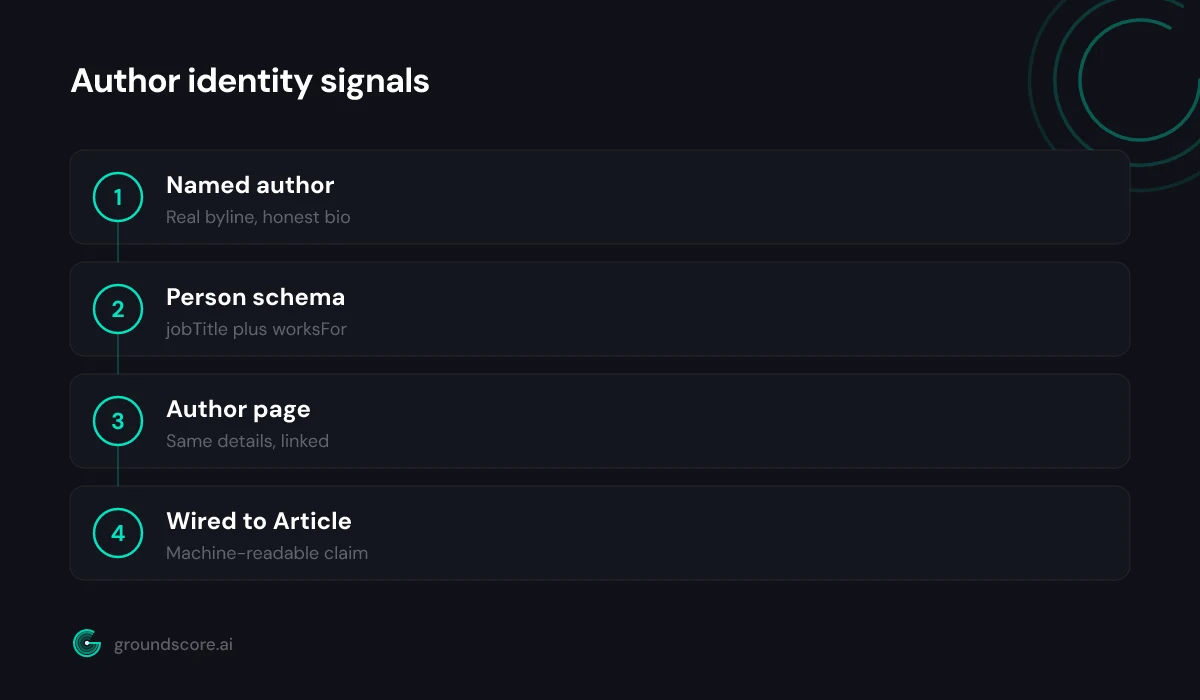
The point of the structure is not decoration. It gives an engine a stable, verifiable claim: this page was written by this named person, who holds this role, at this organization. That is the difference between expertise an engine can act on and expertise it cannot see.
The four components map cleanly to the signals that carry them:
| E-E-A-T component | What it means | Machine-readable signal |
|---|---|---|
| Experience | First-hand use or practice | Author bio, dated notes, original detail |
| Expertise | Depth of subject knowledge | Person schema, credentials, jobTitle |
| Authoritativeness | Recognition beyond your site | Citations, mentions, corroboration |
| Trust | Verifiable identity | Organization schema, consistent details |
Why do AI engines lean on authoritativeness?
Direct answer: AI engines lean on authoritativeness because a citation is a bet on your credibility, and the safest bet is a source other credible places already point to. Recognition beyond your own domain, mentions, references, and consistent presence, corroborates that you are a real authority rather than a self-declared one.
Authoritativeness is the one letter you cannot fully manufacture on your own site. Anyone can write "leading provider" on their homepage. What moves the needle is whether the rest of the web agrees, because that is the signal an engine cannot easily be fooled by.
For AI search, corroboration works a lot like a second opinion. When an engine assembles an answer, sources that are referenced, quoted, or named elsewhere carry more weight than sources that exist only in isolation. A business named consistently across directories, industry sites, and its own profiles looks like a recognized entity. A business that appears only on its own domain looks like a claim with no witnesses.
This is why off-site presence matters even though you do not control it directly. Getting genuinely referenced, being listed accurately where your industry congregates, earning mentions from places engines already trust, all of it feeds the authoritativeness signal. It is slower than editing your own markup, which is exactly why it is worth starting early.
None of this rewards volume for its own sake. A handful of credible, consistent references beats a pile of low-quality ones. The engines are trying to answer a simple question about you: does anyone reputable treat this source as real?
How does trust become verifiable identity?
Direct answer: Trust becomes verifiable when your identity is consistent and machine-readable everywhere your business appears. Organization schema, an identical name, address, and contact details across your site and listings, and clear content attribution let an engine confirm you are a single, accountable entity rather than a set of mismatched pages.
Trust is the foundation the other three letters sit on. Experience and expertise do not count for much if an engine cannot confirm who is behind them. The practical version of trust is consistency: the same organization details, spelled the same way, in every place a machine might check.
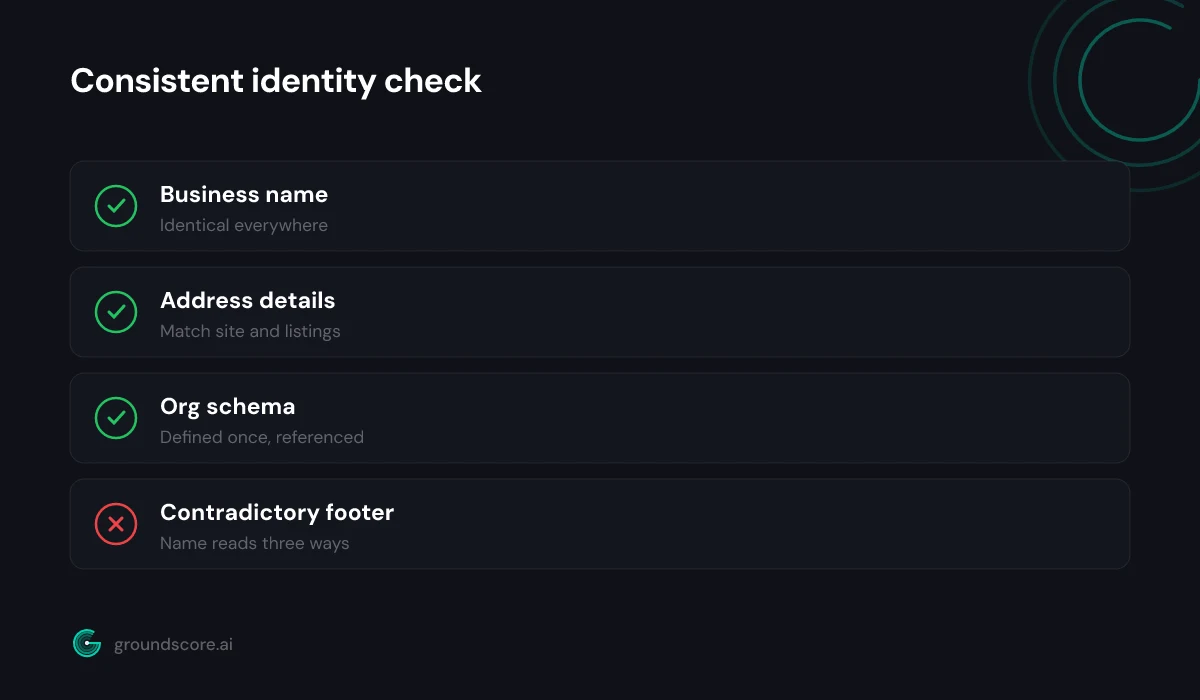
Inconsistency quietly erodes this. A business name that reads three different ways across your footer, your contact page, and your directory listings does not look like deception to a human, but to a system trying to resolve you into one entity, it looks like ambiguity. Ambiguity is the enemy of citation, because engines route trust to entities they can pin down.
Encode the identity layer deliberately. Define your Organization once in schema, with a canonical name, URL, and contact details, and reference it everywhere. Keep the name, address, and phone identical across your site and every external profile. Attribute content clearly so there is never a question of who published it.
We break down the entity side of this in signals AI engines weigh before citing. The short version: trust is not a tone you strike, it is a claim you make consistently enough that a machine can verify it.
How do you encode E-E-A-T on your site?
Direct answer: Encode E-E-A-T by adding named authors with Person schema, defining your Organization once and referencing it everywhere, keeping identity details identical across the web, writing with first-hand specificity, and earning genuine off-site references. Then measure whether engines actually treat you as credible, and fix the weakest signal first.
The work is unglamorous and mostly one-time. Here is the practical arc, roughly in order of leverage.
- Give content a real author. Named byline, honest bio, Person schema with
jobTitleandworksFor. No more anonymous pages. - Define your Organization once. Canonical name, URL, logo, and contact in Organization schema, referenced site-wide rather than redefined per page.
- Make identity consistent. Audit your name, address, and contact details everywhere they appear and make them identical. Fix the mismatches.
- Write from experience. Specific, dated, first-hand detail. The things only someone who did the work would know.
- Earn corroboration. Accurate listings and genuine references from places engines already trust. Slow, durable, worth starting now.
- Measure and prioritize. Check whether engines actually cite you, and put effort into the weakest signal rather than the one you already understand.
That last step is where GroundScore fits. Its Authority and Trust pillar scores exactly these signals, so instead of guessing whether your E-E-A-T is legible to a machine, you get told which part is dragging.
Sequence matters here too. Consistent identity and structured authorship are the foundation; off-site authority builds on top of them over time. Chasing mentions while your own identity signals contradict each other is effort spent in the wrong order.
Frequently asked questions
Is E-E-A-T a ranking factor for AI engines?
Not a single factor you can dial. E-E-A-T is a framework describing the credibility signals engines weigh together when deciding whether to cite you. For AI search, those signals are increasingly read from structured data and off-site presence, so the practical goal is to make each one legible to a machine.
Does the extra E, experience, really matter for AI search?
Yes. Experience is the signal that separates first-hand knowledge from confident guesswork, and AI engines have a strong incentive to prefer sources that actually did the thing. You show it through specific, dated, original detail in the writing and a real author who plausibly has that experience.
Can a small business build E-E-A-T without a big brand?
Yes, and the structured signals are the equalizer. A small business with a named author, clean Organization schema, consistent identity everywhere, and a handful of accurate listings can look more credible to an engine than a larger competitor whose signals are missing or contradictory. Consistency beats size here.
How is E-E-A-T for AI different from E-E-A-T for Google?
The framework is the same; the reader changed. Google's guidelines describe how human raters judge quality. AI engines assemble credibility from machine-readable signals at speed and scale. So encoding E-E-A-T as structured data and consistent identity matters more for AI search than a well-written but unmarked page ever did.
Which E-E-A-T signal should I fix first?
Fix trust first, because it underpins the rest. Make your organization identity consistent and machine-readable everywhere, then add named authorship, then write from genuine experience, then earn off-site corroboration. A measurement tool that scores authority and trust separately will show you exactly which signal is your current floor.
Does schema markup alone create E-E-A-T?
No. Schema makes your real credibility legible, but it cannot invent expertise you do not have. Markup that claims an author or authority the content does not back up is a mismatch engines can catch. The reliable pattern is genuine experience and identity, encoded accurately so a machine can read what is already true.
The bottom line
E-E-A-T did not stop mattering when AI engines started answering questions. It got more literal. The impression a human rater once formed is now assembled from signals a machine reads: who wrote this, who stands behind it, whether the identity holds up across the web, whether anyone else treats you as a source. Real expertise that is not encoded is expertise no engine can see.
The fastest way to find your weakest signal is to measure it. Run a free AI visibility check and see how your Authority and Trust pillar scores today.
How visible is your site in AI search?
Check your AI visibility score in seconds. Free, no account needed.
Check your score